Have you ever watched your trade hit your stop-loss, only to see the market reverse and move exactly in the direction you originally expected?
If you’ve experienced this, you’re not alone. It’s one of the most frustrating situations for beginner traders and often leads them to question their strategy or even believe the market is “against them.”
The truth is, there are several reasons why this happens. Understanding Stop Loss in Forex can help you place your stop-loss more effectively, manage your risk, and avoid making emotional decisions after a losing trade.
What Is a Stop Loss in Forex?
A Stop Loss in Forex is an order that automatically closes your trade when the market reaches a specific price.
Its purpose is simple: to limit potential losses if the market moves against your position.
Instead of hoping the market will eventually recover, a stop-loss helps protect your trading capital and keeps your losses within your planned risk.
Successful traders don’t see stop-losses as failures—they see them as an important part of their trading strategy.
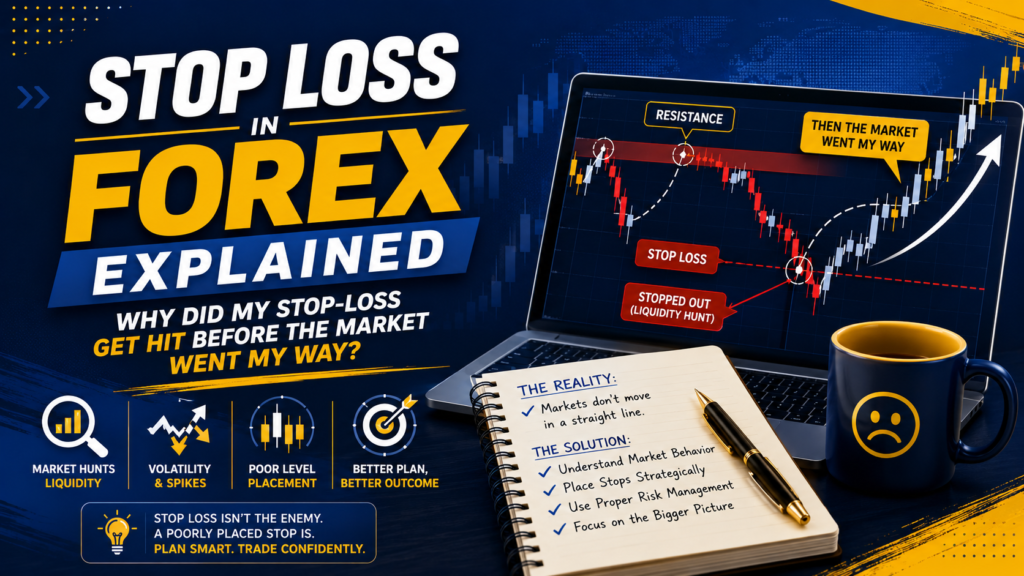
Why Did My Stop-Loss Get Hit?
There are several reasons why your stop-loss may have been triggered before the market moved in your favor.
1. Your Stop-Loss Was Too Tight
One of the most common mistakes beginners make is placing their stop-loss too close to their entry price.
The forex market naturally moves up and down before continuing its direction. These normal price fluctuations, often called market noise, can trigger a stop-loss that doesn’t leave enough room for the trade to develop.
2. Market Volatility Increased
During high-impact news events, such as interest rate announcements or the Non-Farm Payroll (NFP) report, prices can move rapidly within seconds.
Sudden volatility may temporarily push price into your stop-loss before continuing in the original direction.
This is why many experienced traders pay attention to the economic calendar before opening new positions.
3. The Spread Became Wider
Many beginners forget that the spread can increase during volatile market conditions.
When spreads widen, your stop-loss may be reached sooner than expected because buy and sell prices temporarily move farther apart.
Understanding how spreads work is an important part of using a Stop Loss in Forex effectively.
4. Your Trade Needed More Room
Markets rarely move in a perfectly straight line.
Even strong trends experience pullbacks before continuing.
If your stop-loss is placed inside these normal pullbacks instead of beyond important market levels, it may be triggered even though your overall analysis was correct.
How Can You Improve Stop-Loss Placement?
While no stop-loss placement is perfect, there are several ways to improve your decisions.
Place Your Stop-Loss Beyond Key Levels
Instead of placing your stop-loss at a random number of pips, consider placing it beyond important support or resistance levels where your trading idea would truly become invalid.
Consider Market Volatility
Some trading sessions and news events naturally create larger price swings.
Adjust your stop-loss based on current market conditions rather than using the same distance for every trade.
Follow Your Risk Management Plan
Before entering any trade, decide how much of your account you’re willing to risk.
Your stop-loss should support your overall risk management strategy, not be based on emotion.
Wait for Trade Confirmation
Entering a trade too early often results in poor stop-loss placement.
Waiting for confirmation can improve your entry and reduce the chance of being stopped out by short-term market fluctuations.
Should You Move Your Stop-Loss?
After seeing a trade approach their stop-loss, some beginners decide to move it farther away in the hope that the market will recover.
This usually increases risk rather than reducing it.
Unless your trading plan specifically includes rules for adjusting your stop-loss, changing it based on emotions can lead to larger losses and inconsistent results.
A stop-loss should protect your capital—not become a target you keep moving.
Losing Trades Are Part of Trading
Even experienced traders get stopped out.
A stop-loss being triggered doesn’t always mean your analysis was poor. Sometimes the market simply doesn’t behave as expected, and that’s a normal part of trading.
The goal isn’t to avoid every losing trade—it’s to keep losses controlled while allowing winning trades the opportunity to grow.
Successful traders understand that consistency comes from following a well-defined trading plan, not from winning every trade.
Learn Forex Trading With Legendary Trading Academy
At Legendary Trading Academy, we teach students that successful trading isn’t about avoiding losses—it’s about managing them wisely.
Our programs cover Stop Loss in Forex, risk management, price action, trading psychology, and technical analysis to help aspiring traders make informed decisions and develop disciplined trading habits.
Whether you’re just beginning your forex journey or working to improve your consistency, understanding how to use a stop-loss correctly is one of the most valuable skills you can learn.
👉 Learn more about our programs:
https://www.legendarytradingacademy.com
📩 Follow Lady Denily for updates and educational content:
https://www.facebook.com/ladydenilyofficial/
📩 Follow Legendary Trading Academy for updates and educational content:
https://www.facebook.com/legendarycircleacademy