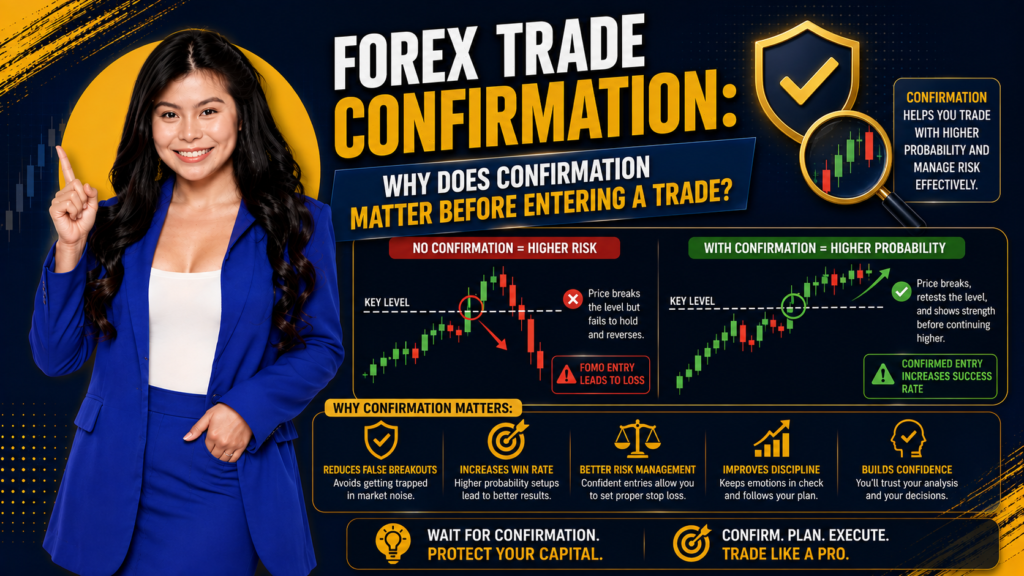
Forex Trade Confirmation is an important concept for traders who want to avoid entering a position simply because the market appears ready to move.
Imagine this:
You see price approaching resistance. The setup looks perfect. Suddenly, price breaks above the level.
Your first thought is:
“This is the breakout. I need to enter now.”
You enter a Buy trade.
A few minutes later, price falls back below the level.
The breakout failed.
Now you’re left wondering:
“What did I miss?”
In many cases, the problem isn’t necessarily the analysis itself. The trader may have entered before there was enough evidence to support the setup.
This is where Forex Trade Confirmation becomes important.
Confirmation does not guarantee that a trade will win. Instead, it gives traders additional information before they commit capital to a position.
What Is Forex Trade Confirmation?
Forex trade confirmation refers to looking for additional evidence that supports a potential trading setup before entering a position.
Instead of acting on one signal alone, traders may look for several factors that align with their strategy.
For example, a trader may identify a resistance breakout but wait for:
- A candle close above the level
- A successful retest
- Supporting market structure
- Momentum confirmation
- Higher-timeframe alignment
Only when the setup meets their predetermined criteria might they consider entering.
The exact confirmation method depends on the trader’s strategy.
Why Does Confirmation Matter?
Markets can move unpredictably.
A price level can break and immediately reverse.
A candlestick pattern can fail.
A trend can change.
A news release can completely alter market sentiment.
Confirmation helps traders avoid treating every initial price movement as a guaranteed opportunity.
It can encourage a more structured approach:
Setup → Confirmation → Entry → Risk Management
Instead of:
Setup → Immediate Entry
The difference may seem small, but it can significantly affect how a trader approaches the market.
Confirmation vs. Prediction
One common mistake among beginners is trying to predict exactly what the market will do next.
For example:
“Price is near support, so it must go up.”
That is a prediction.
A confirmation-based approach is different.
The trader might instead say:
“Price is near support. I’ll wait to see whether buyers actually step in and whether my other entry conditions are met.”
The second approach doesn’t assume that the market must move in a particular direction.
It waits for additional evidence.
Confirmation After a Breakout
Breakouts are one of the most common situations where confirmation can be useful.
Imagine EUR/USD has resistance at:
1.1000
Price moves above the level and reaches:
1.1005
A trader might immediately Buy.
But what if price falls back below 1.1000?
The breakout may have been false.
Instead, some traders wait for price to close above the level and potentially retest it.
A possible sequence could look like:
Resistance → Breakout → Candle Close → Retest → Confirmation → Entry
This doesn’t guarantee a successful trade, but it can provide more information than simply reacting to the first price spike.
Confirmation at Support and Resistance
Support and resistance are common areas where traders look for confirmation.
Suppose price reaches a support zone.
A trader shouldn’t automatically assume that support will hold.
Instead, they may watch for evidence that buyers are actually responding.
Possible confirmation factors can include:
- Rejection candles
- Strong bullish movement
- Market structure changes
- Retests
- Momentum
- Higher-timeframe alignment
Again, confirmation should be based on the trader’s specific strategy rather than a random collection of indicators.
Candlestick Confirmation
Candlestick patterns can provide additional information about price behavior.
For example, traders may watch for signs of rejection around important levels.
A long wick near resistance could indicate that price moved higher but encountered selling pressure.
A strong bullish candle near support could indicate increased buying activity.
However, a candlestick pattern by itself does not guarantee what happens next.
The surrounding market context matters.
A trader should consider the location of the candle, the broader trend, market structure, and other factors relevant to the strategy.
Multiple-Timeframe Confirmation
Another approach traders use is analyzing multiple timeframes.
For example, a trader might use:
Daily chart → Identify broader direction
4-hour chart → Identify important levels
1-hour chart → Look for setup
15-minute chart → Look for entry confirmation
The exact combination depends on the trader’s strategy.
The purpose is to understand whether the setup on a smaller timeframe makes sense within the broader market context.
A Buy setup on a five-minute chart may look attractive, but if the higher timeframe shows strong bearish structure, a trader may decide to wait or avoid the setup.
Retest Confirmation
A retest is another common confirmation technique.
Suppose price breaks above resistance.
Instead of immediately entering, a trader may wait to see whether price returns to the previous resistance area.
If the former resistance holds as support and price begins moving higher again, that may provide additional confirmation.
The sequence could be:
Breakout → Pullback → Retest → Reaction → Entry
However, not every breakout will retest the level.
Sometimes price continues immediately.
Waiting for confirmation can therefore mean missing some trades.
This is an important trade-off traders need to understand.
Market Structure Confirmation
Market structure can also help traders evaluate a setup.
For example, a bullish setup may become more convincing if the market begins creating:
Higher Highs + Higher Lows
A bearish setup may have more supporting context when the market forms:
Lower Highs + Lower Lows
Market structure should be evaluated in relation to the timeframe and trading strategy being used.
It should not be treated as a guaranteed prediction tool.
Momentum Confirmation
Momentum can provide another piece of information.
If price breaks through resistance with strong momentum, the breakout may appear more convincing than a weak move that barely crosses the level.
However, strong momentum can also lead to sharp reversals.
This is particularly important during major economic news.
Therefore, momentum should be considered as part of a broader trading plan rather than used as a standalone signal.
Does Confirmation Guarantee a Winning Trade?
No.
This is one of the most important things beginners need to understand.
Confirmation reduces uncertainty; it does not eliminate it.
Even when multiple factors align, the market can still move against your position.
For example:
- The breakout may fail.
- The retest may break down.
- News may change market sentiment.
- Liquidity may suddenly change.
- The broader trend may shift.
There is no confirmation method that can guarantee a profitable trade.
The purpose of confirmation is to help traders make more informed decisions, not to predict the market with certainty.
Why Entering Too Early Can Be a Problem
Entering too early can expose traders to unnecessary uncertainty.
Consider this situation:
Price approaches resistance.
The trader expects a breakout and enters before the breakout actually occurs.
Price then fails to break the level.
The trader is now in a position based primarily on anticipation.
This can create emotional pressure.
The trader may start thinking:
“Maybe it will still break.”
They might move their stop-loss, hold the position longer than planned, or add to the trade.
Waiting for confirmation can help traders remain closer to their predefined conditions.
The Risk of Waiting for Too Much Confirmation
Confirmation can also be taken too far.
Some traders wait for so many signals that they never enter a trade.
For example:
- Waiting for three indicators
- Waiting for multiple candle patterns
- Waiting for several timeframes
- Waiting for every condition to align perfectly
By the time everything confirms, the market may have already moved significantly.
This creates another problem:
Late entries.
The goal is not to wait for absolute certainty.
The goal is to wait for the amount of confirmation required by your trading strategy.
Common Confirmation Mistakes
Mistake 1: Looking for Confirmation Only After Entering
A trader enters first and then searches for reasons why the trade should work.
This is confirmation bias.
Mistake 2: Using Too Many Indicators
Adding more indicators does not automatically create better confirmation.
Sometimes it simply creates more confusion.
Mistake 3: Changing the Rules During the Trade
If your confirmation criteria say one thing before entering, don’t suddenly change the rules because the position is losing.
Mistake 4: Confusing Confirmation With Certainty
A confirmed setup can still lose.
Mistake 5: Entering Because of FOMO
A trader sees price moving quickly and enters because they don’t want to miss the opportunity.
This isn’t confirmation.
It’s emotional decision-making.
How Beginners Can Practice Confirmation
If you’re still learning Forex trading, you don’t need to immediately use complicated strategies.
Start by observing historical charts.
Find previous breakouts and ask:
Did price close beyond the level?
Did the breakout hold?
Was there a retest?
What happened afterward?
You can also create a simple checklist based on your trading strategy.
For example:
☐ Key level identified
☐ Market structure checked
☐ Breakout confirmed
☐ Retest observed
☐ Entry conditions met
☐ Risk defined
☐ Stop-loss planned
☐ Position size appropriate
The purpose is to develop consistency.
Confirmation and Risk Management Work Together
Confirmation should never replace risk management.
Even a highly confirmed trade can fail.
That’s why traders should determine their risk before entering.
Consider:
- Position size
- Stop-loss placement
- Risk-to-reward ratio
- Account exposure
- Market volatility
- Upcoming economic news
A strong setup with poor risk management can still result in a significant loss.
Likewise, a good risk-management plan can help limit the damage when a confirmed setup fails.
When Should You Avoid Entering?
Sometimes the best confirmation is recognizing that there isn’t enough information.
You may want to remain cautious when:
- Price is moving unpredictably
- A major news event is approaching
- The market is highly volatile
- Multiple timeframes contradict each other
- The setup doesn’t meet your trading rules
- You feel pressured to enter
- You’re trading because of a previous loss
Not taking a trade is also a decision.
You don’t have to trade every market movement.
The Goal of Confirmation Is Better Decision-Making
The purpose of Forex Trade Confirmation isn’t to make trading risk-free.
It’s to encourage traders to slow down and evaluate the setup before taking a position.
Instead of:
“Price is moving. I need to enter now.”
A more disciplined mindset is:
“Does this setup meet my trading conditions?”
That small change can help traders become more patient and consistent.
Learn Forex Trading With Legendary Trading Academy
At Legendary Trading Academy, we believe that learning Forex is about developing knowledge, discipline, and a structured approach to the market.
Understanding Forex Trade Confirmation, market structure, breakouts, reversals, risk management, and trading psychology can help traders build a stronger foundation.
Our structured programs are designed to help aspiring traders develop their understanding of Forex through education, practical discussions, and guided learning.
Whether you’re starting your Forex journey or looking to improve your trading knowledge, learning the fundamentals can help you approach the market with greater confidence and discipline.
👉 Learn more about Legendary Trading Academy:
https://legendarytradingacademy.com/
Follow Legendary Trading Academy
📘 Facebook:
https://www.facebook.com/legendarycircleacademy/
Follow Lady Denily
👩💼 Facebook:
https://www.facebook.com/ladydenilyofficial/
Important Reminder
Forex trading involves significant risk. No confirmation method, indicator, chart pattern, or trading strategy can guarantee profitable results.
This article is for educational purposes only and should not be considered financial or investment advice.