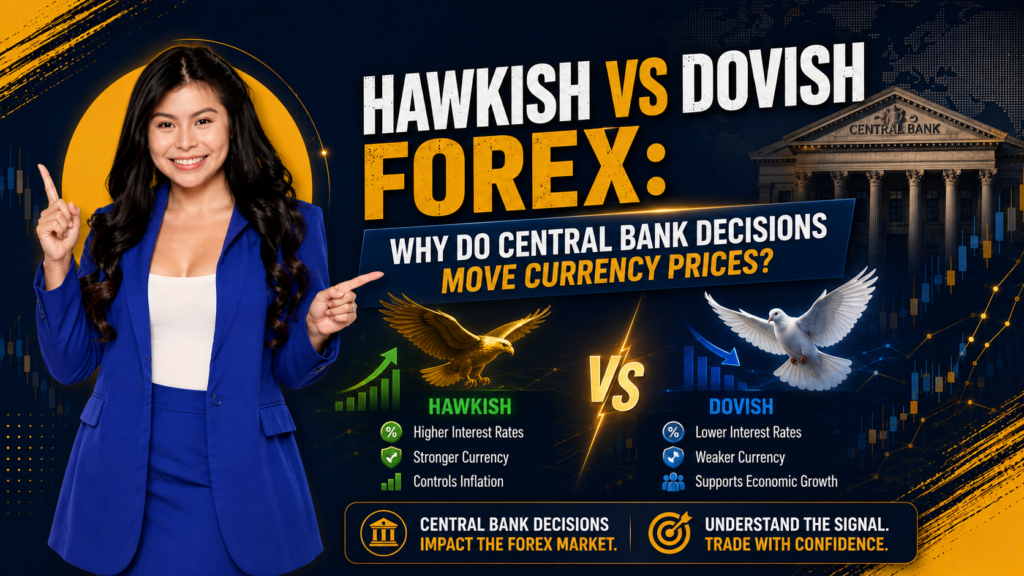
Hawkish vs Dovish Forex is an important concept for traders who want to understand why currencies can suddenly strengthen or weaken after a central bank announcement.
Have you ever wondered why the Forex market reacts strongly to a central bank speech even when there is no immediate change in interest rates?
The reason may be hidden in the language used by policymakers.
Forex traders don’t only pay attention to whether a central bank raises, lowers, or keeps interest rates unchanged. They also listen carefully to what policymakers say about the future.
Are they concerned about inflation?
Are they considering higher interest rates?
Are they becoming more supportive of economic growth?
These signals can influence what traders expect to happen next.
This is where the terms hawkish and dovish become important.
What Does Hawkish Mean in Forex?
In simple terms, a hawkish central bank stance generally means policymakers are more focused on controlling inflation and may be more willing to maintain or increase interest rates.
For Forex traders, a hawkish outlook can sometimes increase demand for a country’s currency because higher interest rates can make assets denominated in that currency more attractive to investors.
For example, if traders believe the Federal Reserve may keep interest rates higher for longer than previously expected, this could influence expectations surrounding the U.S. dollar.
However, a hawkish statement does not automatically mean the currency will rise.
Market conditions, expectations, and other economic information also matter.
What Does Dovish Mean in Forex?
A dovish central bank stance generally indicates that policymakers are more concerned about supporting economic growth or employment and may be more open to lower interest rates or easier monetary policy.
If traders expect interest rates to decrease, demand for a currency may weaken depending on the broader market environment.
For example, if a central bank signals that rate cuts could be coming, traders may adjust their expectations for that country’s currency.
Again, this doesn’t guarantee that the currency will fall.
The market may have already expected the decision, or other factors may be influencing price at the same time.
Hawkish vs Dovish Forex: What’s the Difference?
The easiest way to understand the difference is to think about the direction of monetary policy.
Hawkish
Generally associated with:
- Concern about inflation
- Higher interest rates
- Tighter monetary policy
- Less urgency to cut rates
- Stronger focus on controlling prices
Dovish
Generally associated with:
- Greater concern about economic growth
- Lower interest rates
- Easier monetary policy
- Greater openness to rate cuts
- Support for economic activity
These aren’t rigid rules. Central banks can change their stance depending on economic conditions.
Why Do Central Bank Decisions Move Currency Prices?
Interest rates can influence how attractive a currency is to investors.
When interest rates are relatively high, investors may have greater incentive to hold assets denominated in that currency.
When interest rates are expected to fall, that demand may change.
This creates an important relationship:
Central Bank Policy → Interest Rate Expectations → Investor Sentiment → Currency Demand → Forex Price Movement
This is why Forex traders closely follow central bank decisions and speeches.
What If the Interest Rate Doesn’t Change?
This is where things become interesting.
A central bank can leave interest rates unchanged, yet the currency can still move significantly.
Why?
Because traders are not only looking at what the central bank does today.
They’re also trying to understand what policymakers might do next.
Imagine the market expects interest rates to remain unchanged.
The central bank keeps rates unchanged—but then suggests that rate cuts may happen sooner than expected.
That message could be interpreted as dovish.
Traders may immediately adjust their expectations, potentially causing significant currency movement.
The opposite can also happen.
A central bank may keep rates unchanged but signal that inflation remains a concern and that rates could stay higher for longer.
That could be interpreted as a more hawkish message.
Why Do Central Bank Speeches Matter?
Central bank speeches can provide clues about future monetary policy.
Traders may pay attention to words and phrases related to:
- Inflation
- Interest rates
- Economic growth
- Employment
- Monetary policy
- Financial conditions
- Future policy decisions
Sometimes, a single statement can cause the market to reassess its expectations.
This is why traders should not only focus on economic data releases such as CPI and NFP.
Central bank communication can also be important.
How CPI and NFP Connect to Hawkish and Dovish Policy
This concept connects directly with major economic reports.
For example, imagine CPI comes in significantly higher than expected.
Traders may begin to believe that inflation is more persistent than previously thought.
This could increase expectations that a central bank may maintain tighter monetary policy.
Now imagine NFP shows stronger-than-expected employment growth.
That could provide another piece of information about the strength of the economy.
Central banks consider multiple economic indicators when making policy decisions.
This is why traders often watch CPI, NFP, interest rates, and central bank statements together rather than analyzing one report in isolation.
Why Can a Hawkish Announcement Still Cause a Currency to Fall?
This can be confusing for beginners.
A trader might hear a central bank make a hawkish statement and assume the currency must rise.
But the market doesn’t always behave that way.
One reason is expectations.
Suppose traders were expecting an extremely hawkish announcement.
Instead, the central bank delivers only a mildly hawkish message.
Even though the statement sounds positive, it may be less hawkish than the market expected.
As a result, traders may sell the currency.
This is one reason why understanding market expectations is so important.
Why Can a Dovish Announcement Cause a Currency to Rise?
The same principle works in reverse.
If traders were expecting an extremely dovish announcement and the central bank sounds less dovish than expected, the currency could potentially strengthen.
This shows that Forex trading isn’t simply about deciding whether news is “good” or “bad.”
It’s about understanding how the information compares with what the market already expected.
Should Beginners Trade Central Bank News?
Beginners don’t necessarily need to trade every central bank announcement.
Major policy decisions and speeches can produce rapid price movements, increased volatility, and sudden reversals.
Instead of immediately trading these events, beginners can first observe how the market reacts.
Ask yourself:
- What did the market expect?
- What did the central bank actually say?
- Was the statement hawkish or dovish?
- Did the message differ from expectations?
- How did the currency react?
- Did the initial move continue or reverse?
These questions can help you develop a better understanding of fundamental market analysis.
How Should Traders Manage Risk During Central Bank Events?
Central bank events can create unpredictable conditions.
Traders should consider:
Use Appropriate Position Sizes
Avoid taking unnecessarily large positions during highly volatile events.
Know the Economic Calendar
Be aware of scheduled interest-rate decisions, central bank meetings, and major speeches.
Avoid Emotional Trading
A sudden price movement can create the temptation to enter a trade immediately.
Don’t let fear of missing out replace your trading plan.
Consider Spread and Volatility
During major news events, trading conditions can change quickly.
Spreads may widen and price movements can become much faster.
Have a Clear Trading Plan
Know your entry conditions, risk level, and exit strategy before entering a trade.
Understanding the Language Behind the Market
Learning Hawkish vs Dovish Forex isn’t about memorizing two words.
It’s about understanding how central bank communication can influence market expectations.
When traders understand the connection between inflation, employment, interest rates, monetary policy, and currency demand, economic news becomes easier to interpret.
The goal isn’t to predict every market movement.
Instead, traders should focus on understanding the information available, managing risk, and making decisions based on a structured trading plan.
Learn Forex Trading With Legendary Trading Academy
At Legendary Trading Academy, we believe that learning Forex goes beyond reading charts.
Understanding fundamental factors such as CPI, NFP, interest rates, central bank decisions, and Hawkish vs Dovish Forex can help aspiring traders develop a stronger understanding of why the market moves.
Our programs provide structured Forex education covering market analysis, trading psychology, risk management, and trading discipline.
Whether you’re just starting your Forex journey or looking to strengthen your existing knowledge, building a strong foundation can help you approach the market with greater awareness and discipline.
👉 Learn more about Legendary Trading Academy:
https://legendarytradingacademy.com/
Follow Legendary Trading Academy
📘 Facebook:
https://www.facebook.com/legendarycircleacademy/
Follow Lady Denily
👩💼 Facebook:
https://www.facebook.com/ladydenilyofficial/
Important Reminder
Central bank announcements and economic events can cause significant and unpredictable market movements. Forex trading involves substantial risk, and no fundamental indicator or trading concept can guarantee a profitable outcome.
This article is for educational purposes only and should not be considered financial or investment advice.