Forex slippage can be confusing, especially when you’re new to trading.
Imagine this situation:
You see EUR/USD trading at 1.1000. You decide to enter a Buy trade and click the button.
But when your order is executed, you see that you entered at 1.1003.
You might immediately ask:
“Why didn’t my trade open at the price I saw?”
The difference between the price you expected and the price at which your order was actually executed is known as slippage.
Slippage is a normal part of market execution, particularly when prices are moving quickly or market liquidity changes.
Understanding why Forex slippage happens can help traders develop more realistic expectations about order execution and manage their risk more effectively.
What Is Forex Slippage?
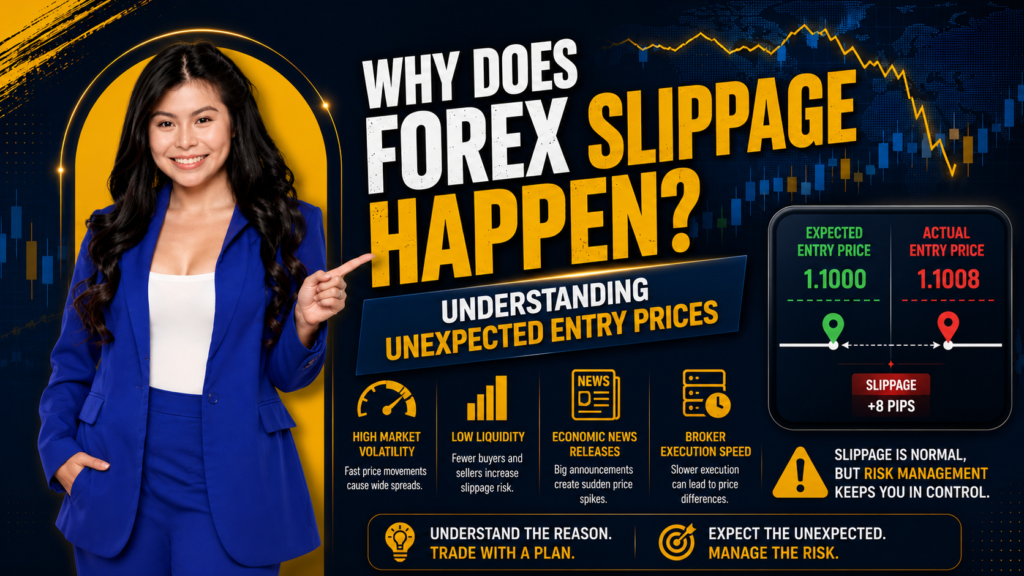
Forex slippage occurs when a trade is executed at a different price from the price a trader expected when placing the order.
For example:
Expected entry: 1.1000
Actual entry: 1.1003
The difference of 0.0003 represents slippage.
Slippage can occur in either direction.
If your order is executed at a less favorable price, it is commonly referred to as negative slippage.
If your order is executed at a more favorable price, it can be considered positive slippage.
The important point is that slippage is related to the execution of an order and the availability of prices in the market.
Why Does Forex Slippage Happen?
The Forex market is constantly moving.
Prices can change between the moment you submit an order and the moment that order is executed.
This can happen extremely quickly, sometimes within fractions of a second.
Several factors can contribute to slippage.
1. Fast Market Movements
When the market is moving rapidly, available prices can change before your order is executed.
For example, imagine EUR/USD is moving from:
1.1000 → 1.1001 → 1.1002 → 1.1003
If you place an order at 1.1000 while the market is moving quickly, the available price may already be different when your order reaches the market.
Your trade could therefore be executed at 1.1002 or 1.1003 instead.
This is one of the most common situations where traders notice slippage.
2. High-Impact Economic News
Slippage can become more noticeable during major economic announcements.
Examples include:
- NFP
- CPI
- Interest-rate decisions
- Central bank announcements
- Major economic reports
- Unexpected geopolitical developments
During these events, prices can move extremely quickly.
For example, an economic report could cause EUR/USD to move significantly within seconds.
If you place an order immediately after the announcement, the price available when your order is executed may be different from the price you initially saw.
This is why news trading can involve additional execution risk.
You can learn more about how major announcements affect market movement in our article:
News Releases in Forex: Why Does the Market Move So Fast During News Releases?
3. Low Market Liquidity
Liquidity refers to how easily an asset can be bought or sold without significantly affecting its price.
When liquidity is high, there are generally more buyers and sellers participating in the market.
When liquidity becomes lower, available prices can change more quickly.
Periods of lower liquidity can therefore increase the possibility of slippage.
This can happen around certain market transitions, unexpected events, or periods when fewer participants are active.
4. Large Price Gaps
Sometimes the market can move from one price level to another without trading at every price in between.
This can create a price gap.
If your order is triggered within that gap, there may not be an available price exactly where you expected your order to execute.
As a result, the order may be filled at the next available price.
This is another reason why stop-loss orders can sometimes experience slippage during rapid market movements.
Positive vs. Negative Slippage
Not all slippage is unfavorable.
Negative Slippage
Negative slippage occurs when your trade is executed at a less favorable price than expected.
For example:
Expected Buy: 1.1000
Actual Buy: 1.1003
You entered 3 pips higher than expected.
Positive Slippage
Positive slippage occurs when your order is executed at a more favorable price.
For example:
Expected Buy: 1.1000
Actual Buy: 0.9998
In this situation, you received a better entry price than expected.
The direction and size of slippage depend on market conditions and order execution.
Is Slippage the Same as Spread?
No.
This is an important distinction for beginners.
Spread is the difference between the Bid and Ask prices.
Slippage is the difference between the expected execution price and the actual execution price.
For example, you might see:
Bid: 1.1000
Ask: 1.1002
The difference between those prices is the spread.
If you place a Buy order expecting 1.1002 but your trade is executed at 1.1004, the additional difference is related to slippage.
Both spread and slippage can affect trading costs, but they are not the same thing.
Can Stop-Loss Orders Experience Slippage?
Yes.
Many traders assume that setting a stop-loss guarantees that their position will close at the exact price they selected.
However, during very fast market conditions, there may not be sufficient liquidity at the stop price.
If the market moves rapidly through your stop level, your order may be executed at the next available price.
For example:
Stop-loss: 1.0950
If the market suddenly moves from:
1.0952 → 1.0945
without sufficient liquidity at 1.0950, your position could potentially be closed below your intended stop price.
This is one reason why traders should understand the risks associated with trading during highly volatile events.
Why Is Slippage Common During NFP and CPI?
NFP and CPI are two examples of economic releases that can create significant market volatility.
When these reports are released, traders quickly compare the actual result with market expectations.
If the result differs significantly from expectations, the market may react rapidly.
This can cause:
- Faster price movements
- Increased volatility
- Changing spreads
- Reduced liquidity at certain prices
- Rapid order execution changes
- Potential slippage
This is why traders should be especially careful when entering positions around high-impact news.
For more information, you can also read our articles about:
NFP Forex Explained: What Is Non-Farm Payroll and Why Does It Matter?
and
CPI Forex Explained: What Is Consumer Price Index and Why Does It Matter?
Can Traders Avoid Slippage Completely?
Not always.
Because market prices are constantly changing, there is no way to guarantee that every order will always be executed at the exact price a trader sees.
However, traders can take steps to reduce their exposure to unexpected execution conditions.
Avoid Unnecessary Trading During Extreme Volatility
If your strategy doesn’t require trading during major news releases, waiting for conditions to stabilize may reduce exposure to rapid price changes.
Use Appropriate Position Sizes
Large positions can increase the potential impact of small price differences.
Proper position sizing is an important part of risk management.
Understand Your Order Types
Different order types have different execution characteristics.
Understanding how market orders, limit orders, and stop orders work can help traders make more informed decisions.
Monitor High-Impact News
An economic calendar can help you identify when major events are scheduled.
Knowing when NFP, CPI, interest-rate decisions, and other major announcements are coming can help you prepare.
Does Slippage Mean Something Is Wrong With Your Broker?
Not necessarily.
A trader may see a different execution price and immediately assume that their broker made a mistake.
However, slippage can occur because market prices change between order submission and execution.
The actual circumstances surrounding an execution depend on the broker, liquidity providers, order type, market conditions, and execution model.
If you experience unusual or repeated execution issues, reviewing your broker’s execution policy and trade records can help you understand what happened.
What Should Beginners Remember About Slippage?
The most important lesson is simple:
The price you see is not always guaranteed to be the price at which your market order will execute.
The Forex market is dynamic.
Prices can change rapidly, especially during major economic events or periods of reduced liquidity.
Understanding this can help beginners avoid unrealistic expectations about trade execution.
Instead of focusing only on finding the perfect entry price, traders should also consider:
- Market conditions
- Liquidity
- Volatility
- Order type
- Position size
- Risk management
- Economic news
Learn Forex Trading With Legendary Trading Academy
Understanding Forex slippage is only one part of becoming a more informed trader.
At Legendary Trading Academy, we believe that Forex education should go beyond simply learning when to Buy or Sell.
Our structured learning approach covers market analysis, risk management, trading psychology, technical concepts, and fundamental factors that can influence the market.
Whether you’re a complete beginner or looking to strengthen your trading knowledge, understanding how the market works can help you approach trading with greater awareness and discipline.
👉 Learn more about Legendary Trading Academy:
https://legendarytradingacademy.com/
Follow Legendary Trading Academy
📘 Facebook:
https://www.facebook.com/legendarycircleacademy/
Follow Lady Denily
👩💼 Facebook:
https://www.facebook.com/ladydenilyofficial/
Important Reminder
Forex trading involves significant risk. Slippage, volatility, spreads, and other market conditions can affect trade execution and potential losses.
This article is for educational purposes only and should not be considered financial or investment advice.