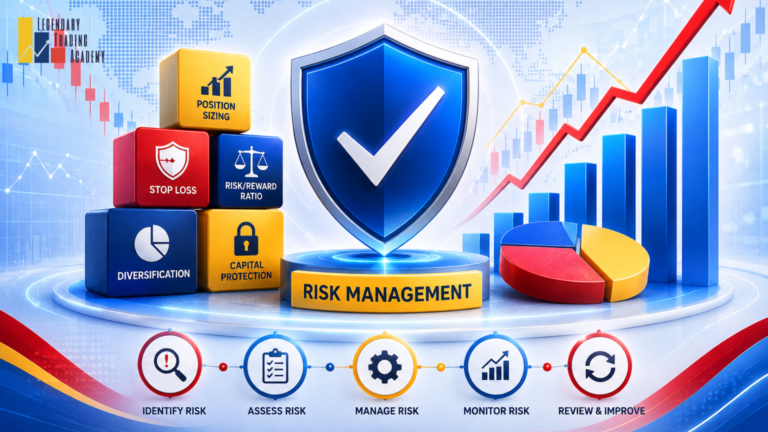
Risk Management is one of the most important skills every forex trader should develop. While many beginners focus on finding winning strategies or predicting market movements, experienced traders understand that long-term success often depends on how well they manage risk.
The forex market can present many opportunities, but it also involves uncertainty. No strategy can guarantee a winning trade every time. This is why Risk Management plays a critical role in protecting trading capital and helping traders stay disciplined during both winning and losing periods.
Understanding and applying proper Risk Management principles can help traders reduce unnecessary losses and build a more sustainable approach to trading.
What Is Risk Management in Forex Trading?
Risk Management refers to the process of identifying, controlling, and minimizing potential losses in trading. Rather than focusing only on profits, traders use Risk Management techniques to protect their capital and maintain consistency.
The goal of Risk Management is not to avoid losses entirely. Instead, it helps traders ensure that losses remain manageable so they can continue participating in the market and learning from their experiences.
1. Never Risk More Than You Can Afford to Lose
One of the most important Risk Management principles is limiting the amount of capital exposed to a single trade.
Many experienced traders choose to risk only a small percentage of their trading account on each position. This approach helps prevent one losing trade from significantly impacting the overall account balance.
By controlling risk at the trade level, traders can better withstand periods of market volatility and maintain a long-term perspective.
2. Always Use a Stop-Loss
A stop-loss is a Risk Management tool that automatically closes a trade when the market reaches a predetermined level.
Using a stop-loss allows traders to define their risk before entering a position. It also helps remove emotional decision-making during periods of market uncertainty.
Without a stop-loss, a small loss can potentially become much larger than expected. For this reason, many professional traders consider stop-loss placement an essential part of their Risk Management process.
3. Manage Your Position Size
Position sizing refers to the amount of capital allocated to a specific trade.
Proper position sizing is a key component of Risk Management because it helps traders control their overall exposure to the market. Even when traders have confidence in a setup, risking too much capital on a single trade can increase the likelihood of significant losses.
Managing position size helps create consistency and allows traders to maintain better control over their accounts.
4. Maintain a Favorable Risk-to-Reward Ratio
Another important Risk Management principle is evaluating the relationship between potential risk and potential reward.
For example, a trader may risk $50 to potentially earn $100, creating a risk-to-reward ratio of 1:2. This means that even if not every trade is successful, the overall strategy may still remain profitable over time.
Understanding risk-to-reward ratios helps traders make more informed decisions and avoid entering trades with unfavorable potential outcomes.
5. Follow Your Trading Plan
A trading plan provides structure and helps traders remain disciplined.
A well-defined trading plan typically includes:
- Entry and exit criteria
- Risk Management rules
- Position sizing guidelines
- Trading goals
- Performance review processes
Following a plan helps traders avoid impulsive decisions that can negatively impact performance. Consistency is often one of the most valuable traits a trader can develop.
Why Risk Management Matters for Long-Term Success
Many beginners believe that success in trading comes from finding the perfect strategy. However, even the best strategies experience losing trades.
This is why Risk Management is often considered the foundation of long-term trading success. Traders who prioritize capital preservation are better positioned to withstand market fluctuations and continue improving over time.
Risk Management helps traders stay disciplined, control emotions, and maintain realistic expectations. More importantly, it provides the framework needed to navigate the uncertainties of the financial markets.
Start Your Trading Education Journey
At Legendary Trading Academy, we believe that Risk Management is one of the foundations of successful trading. Through structured education, mentorship, and practical market discussions, students learn how to approach the financial markets with discipline and confidence.
Whether you’re new to trading or looking to strengthen your understanding of market principles, building strong Risk Management habits can help support your long-term growth and development as a trader.
👉 Learn more about our programs: https://www.legendarytradingacademy.com
📩 Follow Lady Denily for updates and educational content: https://www.facebook.com/ladydenilyofficial/
📩 Follow Legendary Trading Academy for updates and educational content: https://www.facebook.com/legendarycircleacademy