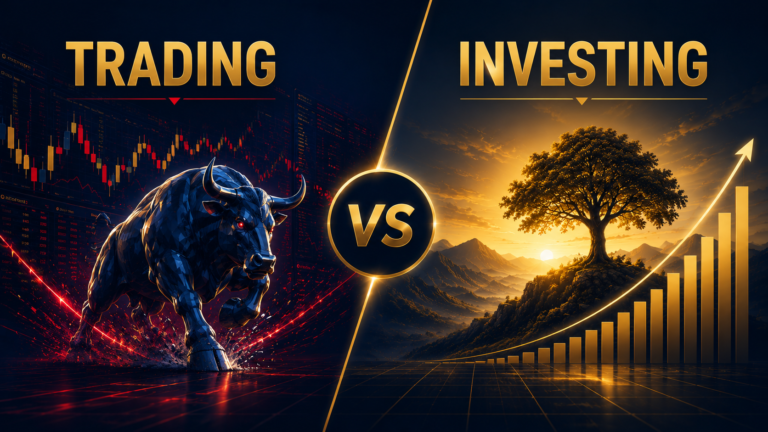
Investing vs Trading is one of the most common questions asked by individuals who want to participate in the financial markets. While both approaches involve buying and selling financial assets with the goal of growing wealth, they differ significantly in terms of strategy, time horizon, risk management, and overall financial objectives.
Understanding Investing vs Trading can help individuals make informed decisions that align with their financial goals, lifestyle, and risk tolerance. Whether you’re looking to build long-term wealth or actively participate in market movements, knowing the differences between these approaches is an important first step.
Investing vs Trading: Understanding the Key Differences
When comparing Investing vs Trading, one of the biggest differences is the time horizon. Investors typically focus on long-term growth by purchasing assets and holding them for several years. Their goal is to benefit from the gradual appreciation of an asset’s value over time.
Traders, on the other hand, focus on shorter-term price movements. Depending on their strategy, traders may hold positions for days, hours, or even minutes. Rather than waiting years for growth, traders seek opportunities created by market fluctuations.
1. Time Horizon
Investing is generally considered a long-term approach to wealth building. Investors often purchase stocks, exchange-traded funds (ETFs), or other financial instruments and hold them for extended periods.
Trading involves a shorter time horizon. Traders continuously monitor market conditions and look for opportunities to enter and exit positions based on price action and market trends.
The choice between investing and trading often depends on how much time an individual is willing to dedicate to the financial markets.
2. Analysis and Research
Another major difference between Investing vs Trading is the type of analysis used.
Investors often rely on fundamental analysis, which includes evaluating company performance, financial reports, industry growth, and economic trends. Their focus is on the long-term value of an asset.
Traders frequently use technical analysis, which involves studying charts, market structure, support and resistance levels, and price movements to identify potential opportunities.
Both approaches require research and education, but the methods used can vary significantly.
3. Risk Management
Risk management is essential whether someone chooses investing or trading.
Investors typically reduce risk through diversification by spreading their investments across multiple assets and sectors. This helps minimize the impact of poor performance from a single investment.
Traders often use stop-loss orders, position sizing, and trading plans to manage potential losses. Because market conditions can change quickly, effective risk management becomes a critical part of the trading process.
4. Time Commitment
Many beginners struggle to choose between Investing vs Trading because both approaches offer unique advantages.
Investing generally requires less day-to-day involvement. Investors may review their portfolios periodically while remaining focused on long-term objectives.
Trading usually requires more active participation. Traders spend time analyzing charts, monitoring market conditions, and adjusting strategies based on new information.
Individuals with limited time may find investing more suitable, while those who enjoy market analysis may be more interested in trading.
5. Financial Goals
Understanding Investing vs Trading can help individuals align their financial decisions with their personal goals.
Investors often focus on long-term wealth accumulation, retirement planning, and financial security. Their objective is to steadily grow their capital over time.
Traders may seek to capitalize on short-term opportunities while developing market analysis skills and trading experience. Success often depends on discipline, consistency, and the ability to manage risk effectively.
Which Approach Fits Your Financial Goals?
There is no single answer that works for everyone. Some individuals prefer investing because of its long-term nature and lower time commitment. Others are attracted to trading because of the opportunities presented by short-term market movements.
The best approach depends on your financial goals, risk tolerance, available time, and willingness to learn. Some individuals even combine investing and trading as part of a broader financial strategy.
Whether you choose Investing vs Trading, continuous learning and proper risk management are essential for long-term success in the financial markets. By understanding how each approach works, you can make more informed decisions and take meaningful steps toward achieving your financial goals.
Start Your Trading Education Journey
Understanding the difference between investing and trading is an important first step toward achieving your financial goals. If you’re interested in learning how financial markets work, improving your market analysis skills, and developing a structured approach to trading, education is essential.
At Legendary Trading Academy, we provide trading education, mentorship, and practical learning opportunities designed to help aspiring traders build confidence and knowledge in the financial markets.
👉 Learn more about our programs: https://members.legendarytradingacademy.com/store
📩 Follow Lady Denily for updates and educational content: https://www.facebook.com/ladydenilyofficial/