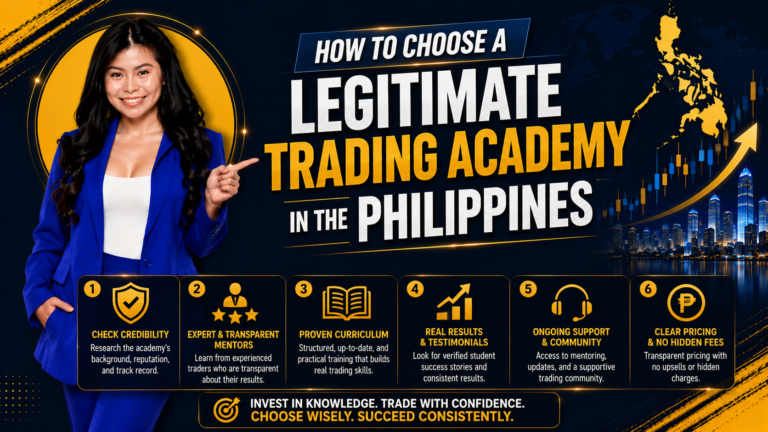
Choosing a legitimate trading academy in the Philippines is an important decision, especially if you are new to Forex trading and don’t know which educational program to trust.
Today, aspiring traders can find countless trading courses, mentors, communities, social media pages, and online programs promising to teach them how to trade.
But not every program offers the same quality of education.
Some may provide structured learning and practical guidance, while others may focus heavily on unrealistic profit claims, expensive signals, or promises of quick financial success.
Before paying for a course, it is important to understand what you are actually getting.
A good trading academy should help you understand the market, manage risk, develop discipline, and build knowledge—not simply convince you that trading is an easy way to make money.
What Makes a Trading Academy Legitimate?
A legitimate trading academy should be transparent about what it offers.
It should clearly explain:
- What students will learn
- Who will teach the program
- How the classes are conducted
- What materials are included
- How much the program costs
- What students can realistically expect
- What risks are involved in trading
Transparency is one of the first things prospective students should look for.
If an academy refuses to explain what is included in its program or relies heavily on vague promises, it may be worth asking more questions before enrolling.
1. Check the Academy’s Business Information
Before paying for any course, research the organization behind it.
Look for information such as:
- Registered business name
- Business contact information
- Physical or verifiable office location
- Official website
- Professional social media accounts
- Clear payment information
- Terms and conditions
- Refund policies
In the Philippines, the Securities and Exchange Commission (SEC) provides systems and resources that allow the public to verify information about registered corporations and partnerships.
However, there is an important distinction.
Company registration does not automatically mean that an organization is licensed to perform every type of financial activity.
The SEC specifically notes that primary registration gives a company juridical personality but does not automatically authorize activities such as investment-taking, selling securities, or other regulated activities.
This distinction is especially important when evaluating organizations that ask people to invest money, promise returns, manage funds, or offer investment products.
An educational academy that sells educational services is different from an entity soliciting investments from the public.
2. Be Careful With Guaranteed Profit Claims
One of the biggest warning signs is a promise of guaranteed income.
Be cautious when you see statements such as:
“Guaranteed profits.”
“No-loss strategy.”
“Earn a fixed percentage every day.”
“Turn ₱10,000 into ₱100,000 quickly.”
“Never lose another trade.”
Trading involves risk.
The Philippine SEC’s investor education guidance specifically warns that there is no such thing as a guaranteed return in currency trading and advises people to understand the mechanics and dangers of foreign currency trading before participating.
A responsible trading academy should explain both the potential opportunities and the risks.
3. Look at the Curriculum
A serious trading education program should have a structured curriculum.
Instead of simply teaching students when to Buy and Sell, it should ideally cover several areas of trading.
These may include:
Forex Fundamentals
Students should understand:
- Currency pairs
- Pips
- Lots
- Spread
- Leverage
- Margin
- Trading sessions
Technical Analysis
Students may learn about:
- Support and resistance
- Market structure
- Trends
- Candlestick patterns
- Breakouts
- Retests
- Indicators
Fundamental Analysis
Students can learn how economic events may influence currency prices.
Examples include:
- NFP
- CPI
- Interest-rate decisions
- Central bank announcements
- GDP
- Employment data
Risk Management
This is one of the most important parts of trading education.
Students should understand:
- Position sizing
- Stop-loss
- Risk-to-reward ratio
- Capital preservation
- Trade management
Trading Psychology
Trading isn’t purely technical.
Students should also learn about:
- Fear
- Greed
- FOMO
- Revenge trading
- Overtrading
- Impatience
- Emotional decision-making
A program that teaches these areas provides a more comprehensive foundation than one focused solely on entry signals.
4. Research the Instructors
The people teaching the course matter.
Before enrolling, research the instructors and mentors.
Look for:
- Public professional profiles
- Trading experience
- Educational background
- Teaching experience
- Public market discussions
- Consistent educational content
- Transparent communication
Be careful with instructors who rely entirely on screenshots of winning trades as proof of expertise.
A few profitable screenshots don’t tell you how someone handles losing trades, risk, drawdowns, or changing market conditions.
A stronger educator should be able to explain why a strategy works, when it may fail, and how risk should be managed.
5. Evaluate the Teaching Approach
Ask yourself:
Does the academy actually teach me how to think, or does it simply tell me what to trade?
There is a major difference.
A signal-focused approach might tell you:
“Buy EUR/USD at this price.”
An educational approach should help you understand:
“Here is why this setup may be considered, what could invalidate it, and how risk should be managed.”
The second approach encourages independent thinking.
The goal of education should be to help students gradually develop their own understanding of the market.
6. Check Whether Risk Management Is Part of the Program
Risk management should not be an optional afterthought.
It should be part of the foundation.
Before enrolling, check whether the curriculum discusses:
- How much to risk per trade
- Position sizing
- Stop-loss placement
- Risk-to-reward ratio
- Drawdown
- Leverage
- Capital preservation
A trader can have a good strategy and still experience significant losses if risk is poorly managed.
That’s why a responsible academy should teach students that protecting capital is part of trading.
7. Look for Realistic Expectations
A legitimate educational program should not make trading sound effortless.
Forex trading requires:
Learning.
Practice.
Discipline.
Risk management.
Patience.
Continuous improvement.
If an academy presents trading as an easy path to immediate wealth, be cautious.
The SEC also advises investors to be wary of quick-profit schemes and high-pressure offers that push people to act immediately.
Education should encourage informed decisions, not pressure.
8. Check Reviews—but Don’t Rely on Them Alone
Reviews can help you understand other students’ experiences.
Look at:
- Student testimonials
- Google reviews
- Social media comments
- Community discussions
- Alumni experiences
However, don’t rely exclusively on testimonials.
A better approach is to combine reviews with your own research.
Ask:
Is the curriculum clear?
Are the instructors transparent?
Are risks discussed?
Is the academy’s information verifiable?
Does the program match what I actually want to learn?
9. Ask About What Happens After the Course
Good education shouldn’t necessarily end when the final class ends.
Ask whether the academy provides opportunities such as:
- Community access
- Mentorship
- Market discussions
- Continued learning
- Alumni activities
- Educational resources
- Practical sessions
Continued learning can be valuable because markets constantly change.
A trader may finish a course knowing the basics but still need time and practice to develop confidence and consistency.
10. Understand the Difference Between Education and Investment Services
This is an especially important point.
A trading academy provides education.
An investment service may involve managing money, soliciting investments, or offering financial products.
These are not automatically the same thing.
If an organization asks you to hand over money for the purpose of generating investment returns, don’t assume that because the organization offers trading education, it is automatically authorized to provide that investment service.
Verify the relevant regulatory status and authority.
The SEC maintains investor advisories warning the public about entities that solicit investments without the necessary licenses or authority.
11. Watch Out for High-Pressure Sales Tactics
Be cautious when someone tells you:
“Enroll today or lose your chance forever.”
“Only five slots left—send payment now.”
“Everyone is already earning.”
“Don’t think too much. Just start.”
Urgency isn’t automatically proof that something is illegitimate, but high-pressure tactics should encourage you to slow down and verify the information.
The SEC specifically advises investors to be cautious of high-pressure warnings and offers that encourage immediate commitment.
You should be comfortable asking questions before paying.
12. Compare Programs Before Choosing
Don’t enroll in the first academy you see.
Compare several programs.
You can create a simple checklist:
The best academy isn’t necessarily the cheapest or the most expensive.
It is the one that best matches your educational needs and provides transparent, responsible, and structured learning.
Questions to Ask Before Enrolling
Before making a decision, consider asking:
What exactly will I learn?
Who are the instructors?
How long is the program?
Are classes live, recorded, or both?
Is risk management included?
Do you teach trading psychology?
Are there practical market discussions?
Is there mentorship?
What happens after I finish the course?
What are the risks of Forex trading?
Is the organization transparent about its business and services?
If an academy is willing to answer these questions clearly, that’s a good starting point for further evaluation.
What a Responsible Trading Academy Should Teach
A responsible trading academy should help students understand that trading is a skill that takes time to develop.
The objective shouldn’t simply be:
“How can I make money quickly?”
A better starting question is:
“How can I understand the market and manage risk responsibly?”
That mindset can change how someone approaches trading.
Instead of chasing signals, students can learn to analyze.
Instead of chasing profits, they can learn to manage risk.
Instead of reacting emotionally, they can develop a trading plan.
Instead of expecting instant results, they can focus on continuous improvement.
Why Education Matters Before Trading With Real Money
Learning before risking capital is one of the most important steps for beginners.
A new trader may understand how to open an account and place a trade within minutes.
But understanding why a trade should be taken—and how much risk is appropriate—takes considerably more learning.
This is why education should come before aggressive trading.
Practice, study, and observation can help beginners become more familiar with the market before making larger financial commitments.
Legendary Trading Academy’s Approach to Forex Education
At Legendary Trading Academy, the goal is to help aspiring Filipino traders develop a stronger foundation through structured Forex education.
Our approach focuses on more than simply identifying Buy and Sell opportunities.
Students can learn about:
- Forex fundamentals
- Technical analysis
- Market analysis
- Risk management
- Trading psychology
- Trading strategies
- Practical market discussions
- Mentorship
- Trading discipline
The objective is to help students understand the market and develop a more structured approach to trading.
We believe education should encourage knowledge, discipline, risk awareness, and continuous learning rather than unrealistic expectations.
Choosing an Academy Is Your Decision
There is no single trading academy that is perfect for everyone.
Your choice should depend on your goals, learning style, budget, experience level, and the type of education you need.
Take your time.
Ask questions.
Research the organization.
Review the curriculum.
Understand the risks.
And most importantly, don’t let promises of quick profits make the decision for you.
Choosing the right educational environment is an important first step in your trading journey.
Start Your Forex Education Journey
If you’re looking for a structured way to learn Forex trading, Legendary Trading Academy offers educational programs designed for aspiring traders at different stages of their learning journey.
Whether you’re completely new to Forex or looking to strengthen your existing knowledge, developing a strong foundation can help you approach the market with greater awareness and discipline.
👉 Learn more about Legendary Trading Academy: https://legendarytradingacademy.com/
Follow Legendary Trading Academy
📘 Facebook: https://www.facebook.com/legendarycircleacademy/
Follow Lady Denily
👩💼 Facebook: https://www.facebook.com/ladydenilyofficial/
Important Reminder
Forex trading involves significant risk and may not be suitable for everyone. No trading academy, strategy, mentor, signal, or educational program can guarantee profits.
Always conduct your own research, understand the risks involved, and verify the relevant registration or licensing requirements before giving money to any person or organization for investment purposes.
This article is for educational purposes only and should not be considered financial or investment advice.